Give time something to work with.
Compounding is easy to describe and surprisingly easy to forget. Growth builds on what is already there, including earlier growth. The early years can look ordinary. Later, the same percentage applies to a larger amount.
Here is a fictional example: RM10,000 invested, no further deposits, and a constant 5% annual real return. “Real” means after inflation, so these values represent today’s purchasing power. This is arithmetic, not a return forecast.
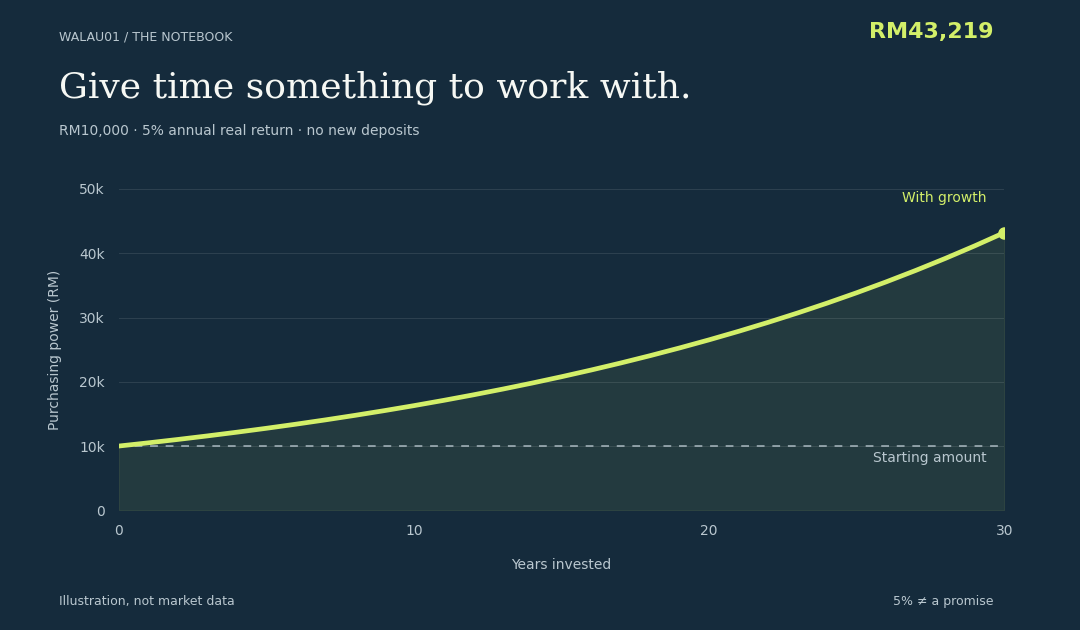
The line is smooth because the assumption is smooth. Real investments rise and fall. Returns can be lower, costs can change, and the time available can be shorter than planned. A useful picture makes its assumptions visible.
Watch the years add up.
The animation below shows the same example one year at a time. The rate stays at 5%; the amount receiving that rate keeps changing. Nothing in the example needs a clever prediction about next month.
The final value matches the static image. The animation is simply another way to see the maths. It does not make the assumed return more likely.
Give growth time, and check the costs.
Time, contributions, and the return left after costs all shape the result. A useful way to read a growth example is to ask which assumptions could change, rather than treat its final number as a promise.
Keep room for the real world.
This is a sample article demonstrating images and animation in the journal. A real retirement plan also needs to account for uncertainty, access to funds, and changing needs. The example gives you a question to investigate, rather than a decision to outsource.